
How to Check Criminal History in Seneca
Start by identifying whether Seneca Police, the municipal clerk, a county jail, or the circuit clerk made the record. The city has no single name-search portal. Calling the right office is therefore part of the search, not a last resort. Ask whether the city keeps a report, daily-log entry, municipal file, or other responsive record.
- Call Seneca Police at 417-776-8158 for a city incident or arrest report and explain the event sought.
- Ask which open portion can be released under Seneca’s records ordinance and whether a written request is needed.
- Contact Court Clerk Pam Ramsey through City Hall for a municipal ordinance case.
- For custody, confirm the destination with Seneca Police, then check Newton County booking at 417-451-8311 or VINELink.
- Use Case.net and the Newton County Circuit Clerk for filed state charges, or MACHS for the separate statewide open history.
This order preserves the difference between allegation, custody, formal charge, and outcome. A no-result response from one source does not settle the others.
Seneca Police Records by Phone
Chief James Altic leads a seven-officer Seneca Police Department at 517 Oneida Street. The public telephone number is 417-776-8158. The research found no dedicated online police request form or publication blotter, so a phone call is the verified first channel for city incident and arrest material.
The official Seneca Police page shows the department’s address and contact information.
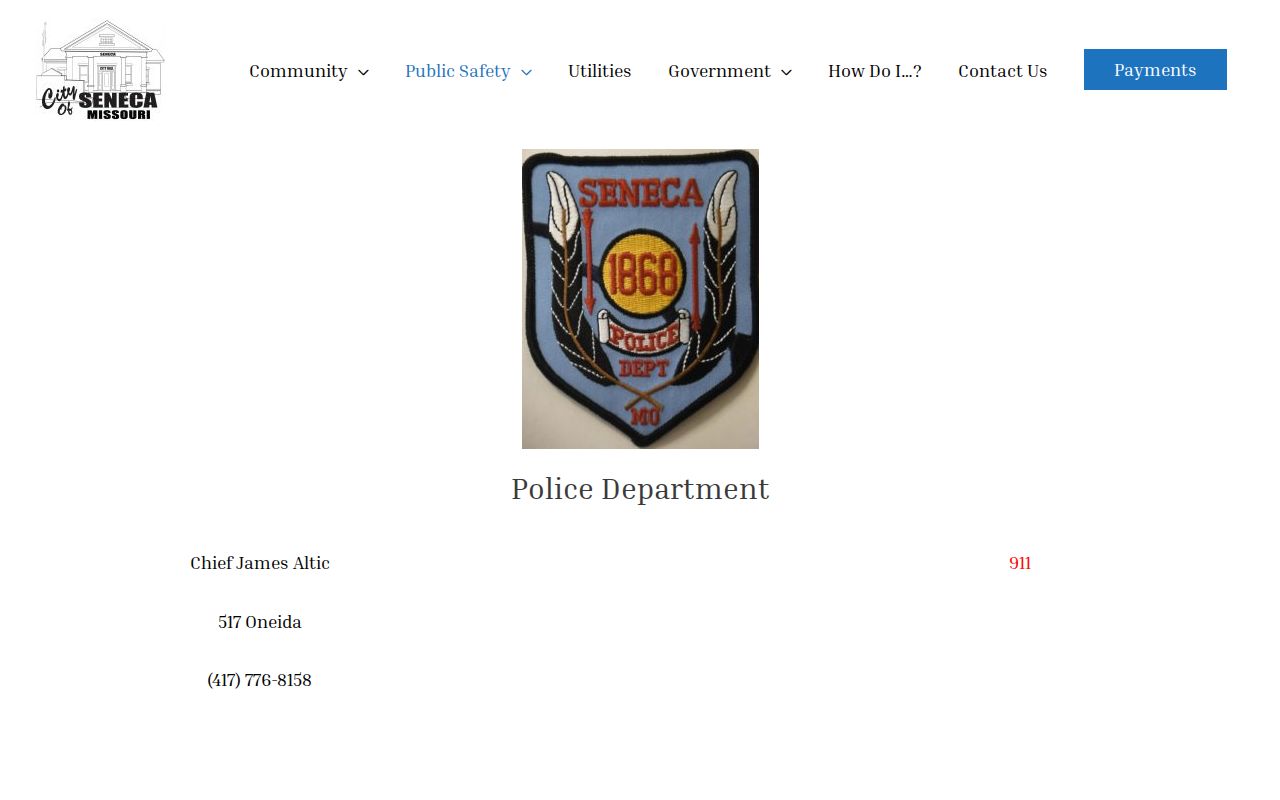
The page confirms where to begin, but it does not provide a searchable record archive. Be ready to give the event date, place, names, and a report number if known. Ask for the records custodian and the preferred submission method rather than assuming email, fax, or a web form exists.
Seneca’s size makes precise facts useful. The official city history says Seneca was platted in 1869 after the Civil War and was named for the Seneca Nation. Present-day city records stops remain close but distinct: police are on Oneida Street, while City Hall and the municipal clerk are on Cherokee Avenue. The street names help a visitor distinguish the two custodians.
The Seneca Police Department
Seneca Police holds the report made by its officers. That file may include the call, response, observations, arrest facts, property, and the status of an investigation. It is not the same as a court docket. If the matter is sent for prosecution, the court creates a second record with a charge and later case events.
A small department may route record questions through staff who handle more than one role. Keep a request narrow. State the document wanted and avoid asking for a vague “full background.” Seneca’s own ordinance draws lines among incident, arrest, and investigative reports. Those terms should guide the request. For an immediate police need, use the official police contact route; for a copy, ask the records custodian how to submit and pay any lawful cost.
Ask staff to confirm the date received and the scope of the request. If only part of the file is open, seek that part rather than waiting for every investigative detail. A report number, dispatch time, or exact location can make a small-office search faster and reduce the chance that a similarly named person or unrelated call is pulled.
Seneca Criminal Report Types
Seneca’s codified open-records ordinance distinguishes report types with unusual care. Incident reports and arrest reports are open. Investigative reports are closed until the matter becomes inactive. That means a public incident summary does not open every interview, lead, or technique in an active investigation.
- Incident report
- The open report about the event, response, and basic facts the city may release under its law.
- Arrest report
- The record of the custody action, subject to later closure when no charge is filed within the statutory period.
- Investigative report
- Material developed to solve or prove the matter, generally closed while the investigation remains active.
- Inactive investigation
- A status that can change the access analysis, though protected facts may still require redaction.
Ask for the specific open record first. If staff withhold investigative material, request the legal basis and any segregable public portion.
Arrests and Bookings in Seneca
Seneca Police creates its arrest report, but the research found no official city booking agreement or published Seneca custody portal. Do not state that every person arrested by Seneca Police is taken to Newton County Jail. The actual destination should be confirmed for the event.
Call Seneca Police at 417-776-8158 and ask where the person was booked. Then call Newton County booking at 417-451-8311 or check VINELink if the county is the likely custodian. If neither source confirms custody, return to the arresting agency for the destination. A later court filing can appear in Case.net. The police allegation, booking charge, and court charge may differ, so retain the report or case number for each step.
Note: Newton County does not publish an online inmate roster, making the police confirmation and official booking phone line central to this search.
Seneca Arrest Records After 30 Days
Seneca’s ordinance follows Missouri’s rule that an arrest report closes when no charge is filed within 30 days. Disposition and exculpatory access remain governed by law. This can surprise a reader who saw a report while it was open and expects the same public access later.
The closure is not proof that the event was erased. Missouri often closes records rather than physically destroying them. Some authorized users and the person involved may retain access under statutory rules. Search the court file for any filing, but do not infer that silence in Case.net proves the report never existed. Ask the police custodian which provision controls the current response and whether an open disposition can be provided.
Later closure can also follow a nolle prosequi, dismissal, acquittal, or successful suspended imposition of sentence under Missouri law. Those court outcomes differ, even if public access narrows afterward. A person reviewing their own Seneca record should identify the exact disposition and ask the court or agency how the closed record can be accessed or corrected.
Seneca Municipal Court Records
Court Clerk Pam Ramsey is the identified Seneca municipal contact through City Hall at 1303 Cherokee Avenue. The city has no verified Seneca-specific online court portal. Begin with the clerk for a city ordinance matter and ask how to inspect or obtain the public file.
The official Seneca board and staff page identifies the municipal clerk contact.
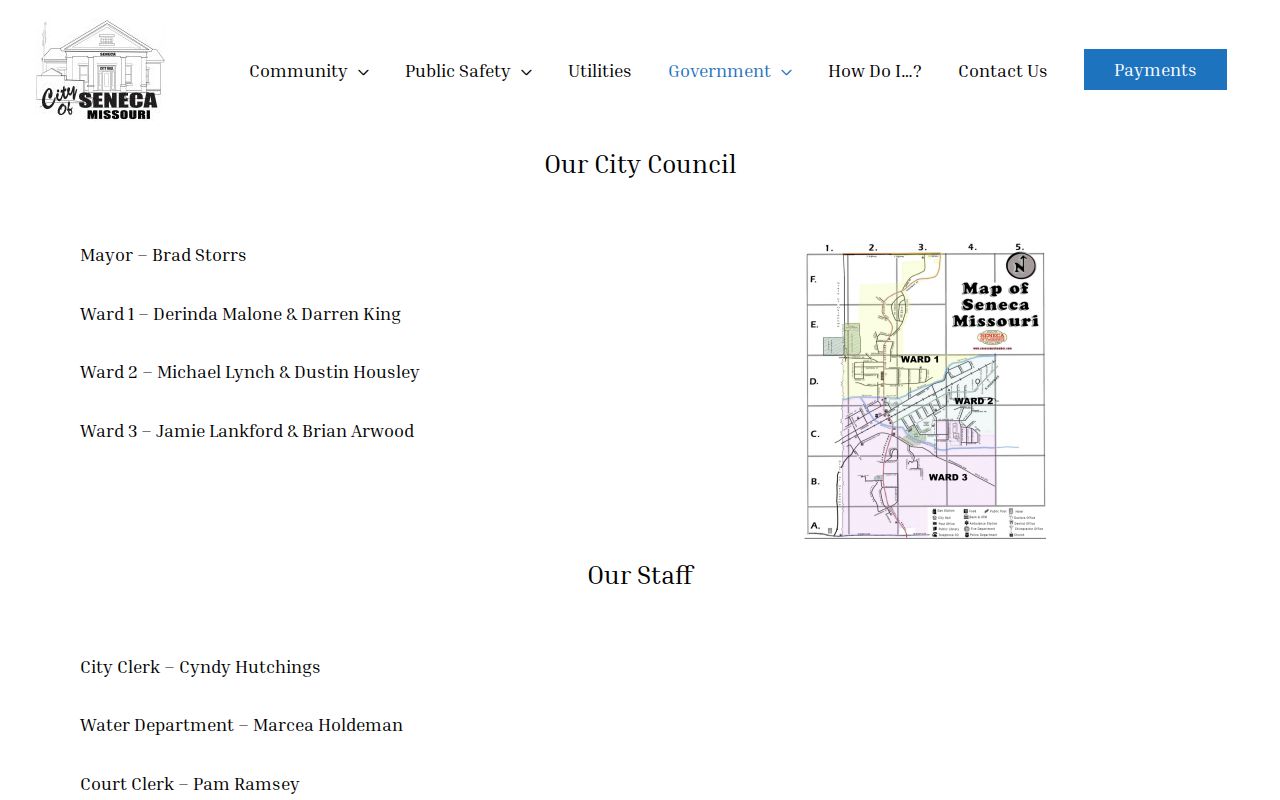
The staff page supplies a local counter route rather than a docket search. Missouri Case.net may provide public court information, but direct clerk contact is still important when no remote document is linked.
| Court Contact | Court Clerk Pam Ramsey through Seneca City Hall |
|---|---|
| Case Types Heard | Seneca city ordinance matters within municipal jurisdiction |
| Case Lookup Channel | Municipal clerk at 1303 Cherokee Avenue; no dedicated city portal was verified |
| What the File Shows | Public charge, settings, court events, disposition, and sentence or conditions when applicable |
| Copies and Fees | Ask the clerk for the current process and cost; no official schedule was found |
Seneca Incident Records for Participants
A person involved in an incident, that person’s attorney, or insurer may request a complete unaltered incident report under the city rule. The ordinance generally calls for release within 30 days unless police seek a circuit-court order to withhold the report because release would harm safety or an investigation.
State the requester’s relationship to the event and ask what proof the custodian needs. “Unaltered” does not mean all information is public to everyone. Victim protections, juvenile law, and other confidentiality rules can still matter. If the department seeks to withhold the report, the ordinance places the court-order step on police rather than allowing an indefinite informal refusal. Keep copies of the request and response dates so the timeline is clear.
Where Seneca Records End Up
Seneca Police retains the city incident and arrest material. A municipal allegation goes to the city court contact. A filed state misdemeanor or felony becomes a Newton County Circuit Court case. Reportable arrest cycles and later dispositions can reach the Missouri State Highway Patrol’s central repository.
Record flow: Seneca Police Department › Newton County Courts › Missouri State Highway Patrol CJIS Central Repository
Each link in that chain has a different scope. Police can explain the original event. The circuit clerk holds the formal prosecution record. MACHS provides Missouri open repository data and may exclude closed information. Readers who need the complete county court sequence can use the Newton County criminal court case channels once a state filing is identified.
A name match is not identity proof. MACHS name searches can return possible matches, while a fingerprint comparison ties a record to a person more firmly. For a recent Seneca event, though, the local report and court cause number remain the best anchors. They help separate city activity from an older statewide record with a similar name.
Seneca Daily Criminal Record Details
Seneca’s local law describes what a daily log must disclose if the city maintains one. Public details include the time and substance of calls, the agency response, the time and place of occurrence, circumstances, injuries or property damage, and weapons. Victim information is subject to the special protections tied to Chapter 566 offenses.
The phrase “if maintained” is crucial. The research did not locate an online Seneca blotter or confirm that a public daily log is currently published. Ask the police custodian whether such a log exists for the date at issue. Do not describe the ordinance’s required fields as proof that a searchable archive is online. If a log exists, it can help identify the report number or event before a more specific request is made.
A log entry is still a summary. It may show the time, place, response, harm, and weapon facts without supplying the full officer narrative. Use it to narrow the event, then request the open incident report. If an investigation remains active, expect the city to separate releasable facts from closed investigative work.
Seneca 911 Facts and Audio
Seneca’s ordinance treats 911 audio differently from basic incident facts. The recording is generally closed, while certain immediate facts about the event remain public. A request for “the 911 record” should therefore say whether the reader wants the audio, dispatch facts, call time, location, response, or associated incident report.
| Record | General Seneca Rule | Request Approach |
|---|---|---|
| 911 audio | Generally closed | Ask if a legal exception applies; do not assume release |
| Immediate incident facts | Certain facts remain public | Name the event and seek the open factual fields |
| Incident report | Generally open, with protected parts removed | Request from Seneca Police |
This split lets the city protect the recording while still providing public event information. It also explains why a denial of audio is not a denial of every record tied to the call.
Public Access Rules
Seneca’s local ordinance works with Missouri Sunshine Law. Public access begins with a presumption of openness, but active investigations, confidential identifiers, protected victims, juveniles, and closed criminal records remain subject to statutory limits. The city can release open portions and redact the rest.
The official Seneca records ordinance provides the city-specific rules for incident, arrest, investigative, daily-log, and emergency-call records.
The ordinance is unusually useful because it explains operational distinctions that many small departments leave unstated.
Key Statutes:
Missouri Sunshine Law §610.011 states the policy favoring open public records.
RSMo §610.026 governs copying costs, research time, estimates, and advance payment.
RSMo §610.100 governs incident, arrest, and investigative report access and the no-charge closure rule.
Ask for a written explanation when material is withheld. A city report response does not control access to a separate Newton County court record.